
Looking Deeper with SOCA: A Medium of Becoming
What if the simple act of looking could change the way we see ourselves?
At Soca, Mia Diwasasri’s solo exhibition at RAD, that question invites us to pause and look closely, not just at what’s in front of us, but also at what’s looking back. Soca, meaning eye in Sundanese, opens a meeting point between sight and reflection, that is, between what is visible and what hides beneath.
If you have the chance to see Mia’s exhibition from 22 August to 20 September at RAD, you will for sure notice this invitation from the moment you walk in. You begin to notice so many eyes, it’s everywhere. Moss-green, ocean-blue, soft brown, deep black. Some follow you with quiet curiosity, others seem lost in thought, while a few meet your gaze head-on with straightforward honesty. Through them, Mia conveys the act of seeing and of being seen. Of how every glance carries both distance and intimacy, how we are always somewhere between revealing and concealing ourselves from other people's gazes.
Who is Mia?
Born in Bandung in 1975, Mia Diwasasri’s creative journey began at the Faculty of Art and Design, Institut Teknologi Bandung (ITB), where she majored in ceramics. Her early years were shaped by discipline and technique, but her true language is rooted in curiosity.
Over the years, Mia has lived many lives: as a student, a sister, a wife, a mother, a teacher, a friend, and an observer. Each role brought with it new textures, new fractures, and new ways of seeing. When she moved to Bali in 2018, something began to shift. The noise of the city gave way to the rhythm of the tide. The urgency of career was replaced by the slowness of time. In that space, she began to breathe differently, and to paint differently.
Since then, her works have appeared in exhibitions across Indonesia, from Seminyak Design Week to NeoPitamaha, Ways of Dreaming, Into Transition, and Parallels: Legacies in Flux. Across ceramics, watercolor, and acrylic, Mia’s language has remained tender, intuitive, and deeply connected to life’s transformations.
But perhaps what truly defines Mia is how her art is the product of her keen eye, and how it seems to thrive on looking more closely at unseen entities. Quite interestingly, beyond her formal artistic practice, Mia is also a professional paranormal practitioner. To note, this is not an ability she actively sought, but one she simply received. This makes the recurring theme of eyes in her work feel deeply personal and precise.
So naturally, for Mia, the eye becomes a powerful metaphor. It becomes some kind of a bridge between the physical and metaphysical realms. Through painting and ceramics, she releases emotional residue and negative energies gathered from her spiritual work. Art becomes her grounding outlet that translates unseen experiences into a more physical form. In this sense, her practice is not merely expressive, but restorative both for herself and for those who see her works.
Seeing, and Being Seen
When you stand in front of Mia’s work, something interesting happens. You will start noticing yourself noticing things (which is the intention, for sure). In other words, Mia’s paintings and ceramic forms become mirrors.
Because of her spiritual sensitivity, Mia often encounters ancestral presences. These figures frequently appear in her works, woven subtly among human forms, animals, and symbolic elements. This creates an underlying thread of ancestry, identity, and heritage throughout the exhibition. As a result, Soca becomes not only a reflection of personal identity, but also a dialogue with lineage, somewhat an exploration of how past lives, inherited energies, and collective memory shape who we are becoming.
Like in one piece titled “Madya” (2025), Mia places one key subject at the center, surrounded by familiar faces, lush plants, and a single watching eye above. The scene feels intimate and almost devotional as if we’re witnessing a private moment. It’s about presence. About sitting and observing with what surrounds and built you—your memories, ancestry, emotions—and letting it all coexist. Here, “madya” (the middle) becomes a living space where the personal meets the spiritual.
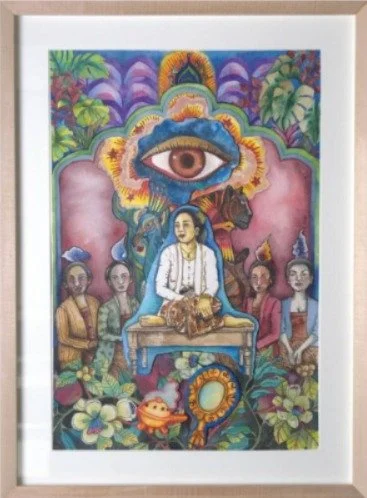
"MADYA", Watercolor mixed media, 38 x 56 cm, 2025
Elsewhere, in “Lamas” (2025), animals and human figures coexist with ease. Like a snake winding through air, a bird carrying a cup of water, eyelids scattered like seeds. These surreal juxtapositions are not random but reflect the fractured nature of human identity. We are indeed many things at once. We can be grounded and, at the same time, adrift. And that’s okay. That is just how life is.
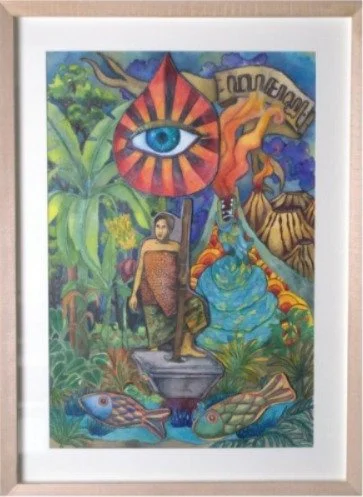
“LAMAS", Watercolor mixed media, 38 x 56 cm, 2025
Mia also explores another medium through stoneware underglaze, like in “Kulon,” “Kaler,” and “Pakuan,” shaping eyes into tactile ceramic forms that feel both ancient and intimate. These small sculptures ground her spiritual imagery in something physical, something you could almost hold. It’s a shift in material that somehow deepens her practice with hand-warmth and touch.
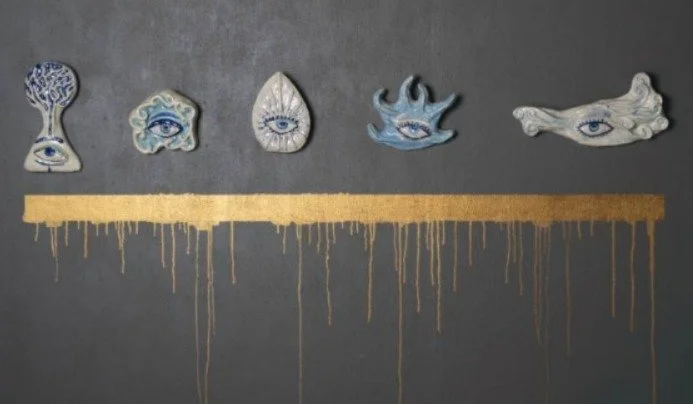
"KULON", "KALER", "PAKUAN", "WETAN", "KIDUL”, Stoneware underglaze (high fire), size varied, 2025
In that way, the act of being watched in Mia’s world highlights the importance of recognition. It’s about allowing yourself to be seen, even when you feel scattered and incomplete or, just like above, adrift and isolated from the rest of the world.
Like many women, Mia understands the weight of invisible expectations. The neverending “social lenses” that dictate how we move, dress, love, and live. In this sense, her eyes on canvas are not just symbols but also acts of taking back our own power. They also remind us that true intimacy requires risk of being perceived and seen in all our capacity as a human. Moreover, they remind us that to meet another’s gaze honestly, we must first dare to meet our own.
Digging deeper to Mia’s inspiration, in Balinese Hindu philosophy, every person is born not as a singular being but as a constellation. The Kanda Pat belief speaks of four divine companions–getih (blood), lamas (fat), yeh nyom (amniotic fluid), and ari-ari (placenta)--who accompany us from birth, guiding us toward our true center, the pancer.
This worldview echoes through Mia’s art. Her works seem to whisper that we are never one thing. That within each of us are contradictions, layers, and echoes of different selves, all learning to coexist.
When Mia Meets RAD
Ruang Arta Derau (RAD) has always been a home for process and the perfect grounding place for artists who see creation not as a finish line but as a dialogue. Founded by Arta Derau and architect Herwaman Dasmanto, the space began with Sekar Puti’s ceramic studio and Agugn’s printmaking studio, later expanding into RPFF, a risograph print lab dedicated to experimentation and community exchange.
Soca unfolded at RAD as an immersive experience, curated by Keni Soeriaatmadja. From installation to opening night, everything centered around process, presence, and connection. The opening night felt warm and intimate, where visitors can wandered slowly between works. A local bartender, Wisnu, served ginger rum cocktails alongside fresh lime juice mocktails, Derau Coffee was open on-site, and DJ Rika (Yuniorika) set a subtle soundscape that blended beautifully with the reflective atmosphere. Rather than feeling like a formal opening, Soca felt more like a shared moment—quiet, grounded, and deeply human.
Mia’s works naturally align with RAD’s vision of art as an ongoing dialogue rather than a final statement. RAD is deeply committed to supporting contemporary practices, especially emerging artists—while also believing that “emerging” doesn’t have to mean young. Mia, now approaching her fifties, embodies this idea. After moving through many chapters of life, including motherhood,a heart diagnosis, work, and shifting priorities, her creative energy feels stronger than ever. While many of her peers started their artistic paths much earlier, Mia chose to fully step into hers now. Her journey reflects one of RAD’s beliefs: that artistic path has no expiration date.
Looking ahead, Soca may continue beyond the gallery walls. There are plans for public watercolor and drawing classes, and possibilities for a zine or even a coloring book inspired by Mia’s visual language, extending the exhibition into participatory and educational formats.
—
So for real, when visitors step into Soca at RAD, they will find eyes. In fact, they will find many of them. But instead of judging, they simply listen and witness. They remind us that the act of seeing is how we connect with each other and ourselves, and ultimately, how we become.
Because maybe the real question Soca asks is not, “What are you looking at?” but rather, “What do you see when the gaze looks back at you?”
And this was perfectly captured in Mia’s Soca exhibition.